Hiring in Kenya


- Minimum wage
- Varies by role and area
- Average salary
- KES 988,177.50 / year
- Employer contributions
- 7.5%
- Income tax
- 10–35%
- Paid leave
- 21 working days
- Public holidays
- 11 national
- Probation
- up to 12 months
- Notice period
- 0–28 days by pay cycle
General information, not legal or tax advice — confirm with a local adviser before you act.
Contents
A foreign company can hire in Kenya through its own employer setup, a Kenyan legal-employer EOR, or a contractor arrangement where the services are genuinely independent.
A payroll agent leaves the foreign company as legal employer, while a legal-employer EOR contracts with the worker. For genuinely independent engagements, 4dev.com's Contractor Platform works with contractors in Kenya.
Three ways to hire in Kenya
Start with who will employ the worker. If the service is genuinely independent, the contractor route follows the services contract.
| Route | Legal employer | What you pay on top of salary | How you end it |
|---|---|---|---|
| Your own entity | Your Kenyan entity or foreign company employing directly, subject to Kenyan employment and payroll duties | 7.5% below the NSSF ceiling; plus KES 50 monthly NITA levy and WIBA insurance | 0–28 days by pay cycle, unless the contract provides longer notice |
| Employer of record | The Kenyan legal-employer EOR contracts with the employee | 7.5% below the NSSF ceiling; plus KES 50 monthly NITA levy and WIBA insurance | 0–28 days by pay cycle, unless the contract provides longer notice |
| Contractor | No employer where the service is genuinely independent | The agreed service invoice, rather than salary | Under the services contract |
The 7.5% is a selected employer contribution subtotal: 6% NSSF across the KES 0–9,000 and KES 9,000–108,000 bands, plus 1.5% employer Affordable Housing Levy. NSSF reaches an employer cap of KES 6,480 a month. The fixed KES 50 NITA levy and WIBA insurance sit outside that percentage; the insurance premium depends on the employer's risk classification. An invoice alone does not make a relationship independent if the working reality shows employment.
The Kenyan labour market
KNBS recorded 21.6 million jobs in 2025, excluding small-scale agriculture and pastoral activities. Of these, 18.1 million were in the informal sector, which accounted for 87.2% of the 822.1 thousand jobs added that year. Salary references need a defined population, period and role before they can inform an offer.
Outside Nairobi, Mombasa's port has conventional and container terminals plus facilities for bulk and petroleum cargo. Kisumu's lake port links rail and water cargo routes among Kenya, Uganda and Tanzania. KNBS's 2024 Gross County Product report, covering 2019–2023 county output, attributes 5.2% of national gross value added to Nakuru.
For hiring, port and logistics roles are a practical starting point to test in Mombasa and Kisumu, while Nakuru merits a broader role-specific search. These activity indicators do not measure available candidates or local pay, so check the required skills and salary range with local recruiting evidence before choosing a location.
Salary reference points
| Modern private and public sectors | KES 988,177.50 / year — provisional 2025 annualised June earnings per employee | KNBS Economic Survey 2026 |
| Same modern-sector benchmark | KES 82,348.13 / month — annual figure divided by 12; a computed reference, not an observed 2026 monthly salary | KNBS Economic Survey 2026 |
| Private-sector information and communication | KES 1,438,060.0 / year — 2025 average annual wage earnings | KNBS Economic Survey 2026 |
| Nairobi senior software engineer, 5–8 years | KES 340,000 gross monthly median in 2025; KES 220,000 at the 25th percentile and KES 520,000 at the 75th | Two Max Group 2025 market data |
KNBS covers modern-sector employees, while the indicative Nairobi figure covers a specific senior software-engineer role; neither is a city-wide or all-worker median. Match the proposed hire's role, sector and population before using either in a budget.
Registering as an employer, step by step
Before the first Kenyan payroll, establish who employs the worker, then create the tax and worker-registration records. The registry estimate below covers only one step.
| Step | What happens | Takes |
|---|---|---|
| Choose and register the legal presence | Register a private limited company through the BRS fee schedule for KES 10,650, or a foreign-company branch for KES 7,550 | 3–5 days for the BRS registry step only |
| Create the tax record | Start company or partnership PIN registration in iTax with the registration certificate, director PINs and IDs; register for PAYE before employing staff | No combined timeline published |
| Register employer and workers with NSSF | Register the employer and each worker; build SHIF deductions into payroll records | Within 21 days of employment for NSSF registration |
| Add the training levy record | Register as a NITA levy payer if operating as an employer in Kenya | No registration timeline published |
| Run payroll and remit statutory lines | Deduct PAYE and run the monthly statutory payroll calendar | PAYE and NSSF: ninth day of the following month; AHL: ninth working day after month-end |

A foreign company may employ directly without an automatic Kenyan-registration requirement under the Employment Act. Local payroll, tax and permanent-establishment questions still apply, and no total time to a compliant first payroll is verified.
Hiring and onboarding
The written particulars, wage-order row and payroll registrations all need attention when an employee starts. The checklist below connects the contract terms to the first remittance dates.
Employment terms and legal limits
The written particulars must identify the employer and employee, job, start date, duration, workplace and hours, and must be provided within two months of starting. For employment lasting more than one month, wages are due at the end of each month or part thereof; the contract must also address reasonable housing or a sufficient rent amount unless housing is lawfully consolidated into pay or covered by a collective agreement.
Probation may run for up to six months and reach up to 12 months only through an agreed extension. A probationary termination requires at least seven days' notice or wages in lieu, and the fair-hearing qualification still applies. Maintain approved WIBA insurance unless the statutory security exemption applies.
Onboarding checklist
- Record the signed employment terms, job, start date, workplace, hours, pay frequency, housing treatment and probation terms.
- Collect the employee's identification and PIN details needed for the payroll record.
- Register the employer and worker with NSSF within 21 days of employment, and configure the worker-side SHIF deduction in payroll.
- Register for PAYE, apply the employer and employee Affordable Housing Levy lines, and register as a NITA levy payer where required.
- Check the applicable wage-order occupation and area, and confirm how housing is provided or consolidated.
- Assign an owner to review role-specific safety needs and check the hiring process for discrimination before the start date.
- Obtain and retain the approved WIBA insurance record for the role.
- For a foreign hire, confirm work authorisation before the start date; a Class D case is tied to a specific employer and job.
- Set the remittance calendar: PAYE and NSSF by the ninth day of the following month, and AHL by the ninth working day after month-end.
Visas and work permits for hires in Kenya
A locally hired foreign employee and a foreign remote worker use different permit routes in Kenya.
A Kenyan local job: Class D
Class D is for a foreign national offered a specific job by a specific employer where the skills are unavailable locally. The application requires employer documents, a Kenyan understudy and evidence of local recruitment; Immigration lists a KES 20,000 non-refundable processing fee and a KES 500,000 annual issuance fee, with EAC member-state fees gratis.
Remote work for an overseas company or overseas clients: Class N
Class N is a separate route for a foreigner working remotely within Kenya for an overseas registered company or serving clients outside Kenya while self-employed. It is issued for one or two years and renewable, subject to eligibility; the checklist calls for Form 25, a signed cover letter, employer or company letter, proof of income and accommodation, and a home-embassy no-objection letter.
Match permit, contract and payroll records
- Match the employment contract, payroll record and permit application to the employer and work described in the relevant permit route.
- For a local Kenyan job, keep the Class D employer, role, recruitment evidence and understudy records consistent.
- For remote overseas work, keep the Class N application focused on the overseas company or clients and the proposed work in Kenya.
- Do not assume an EOR can sponsor every permit; eligibility and application requirements remain route-specific.
Minimum wage: find the occupation and area first
The applicable minimum wage Varies by role and area, so identify the wage-order row and location before setting pay.
| General labourer — five named cities | KES 18,047.40 / month basic, excluding housing | Kenya Law LN 108 |
| General labourer — former municipalities, Mavoko, Ruiru and Limuru | KES 16,650.95 / month basic, excluding housing | Kenya Law LN 108 |
| General labourer — other areas | KES 9,628.07 / month basic, excluding housing | Kenya Law LN 108 |
| Unskilled employee — agricultural industry | KES 9,196.93 / month consolidated | Kenya Law LN 109 |
The corrected General Order is deemed effective from 1 May 2026. Its general-labourer rates exclude housing, while the separate agricultural schedule is consolidated. Neither supplies a single national floor for every role. Housing must be provided or addressed through a sufficient rent amount unless the contract lawfully consolidates a housing element into salary or a collective agreement covers it; check the applicable order and contract before adding a housing amount to pay.

Taxes and contributions
Employer NSSF and Affordable Housing Levy are additions to salary; PAYE, SHIF and the employee's own NSSF and housing-levy lines are deductions from it. The NSSF ceiling changes the effective employer percentage at higher salaries.
Employer and employee payroll lines
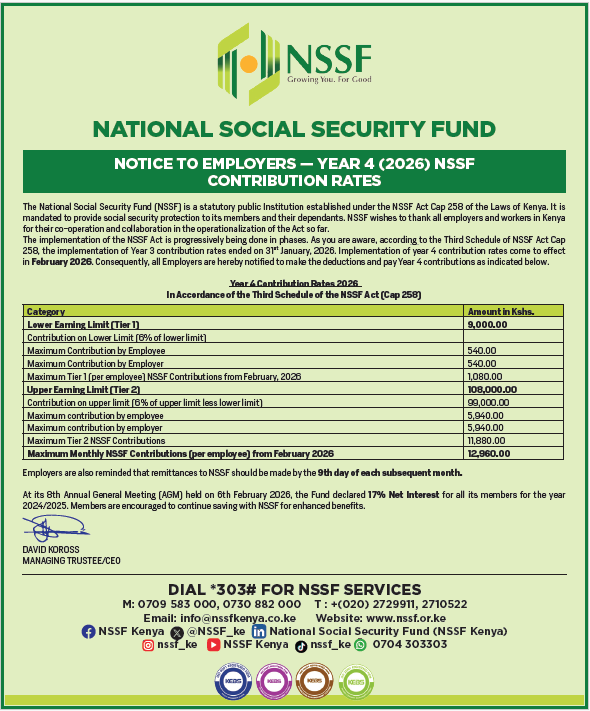
| Employer NSSF Tier I | 6% of earnings from KES 0–9,000; maximum KES 540 a month | NSSF Year 4 notice |
| Employer NSSF Tier II | 6% of earnings from KES 9,000–108,000; maximum KES 5,940 a month | NSSF Year 4 notice |
| Employer NSSF total | Maximum KES 6,480 a month at or above KES 108,000 | NSSF Year 4 notice |
| Employer Affordable Housing Levy | 1.5% of gross monthly salary | KRA Affordable Housing Levy notice |
| Employer NITA levy | KES 50 per employee a month | NITA Levy Inspectorate |
| Employer WIBA cover | Approved work-injury insurance; the premium depends on the employer's risk classification | Work Injury Benefits Act |
| Employee PAYE | 10–35%, subject to the applicable bands and relief | KRA PAYE |
| Employee SHIF | 2.75% of gross salary or wages, with a KES 300 monthly minimum | Social Health Insurance Regulations |
| Employee NSSF and Affordable Housing Levy | Separate employee deductions; the employee has their own 6% NSSF and 1.5% Affordable Housing Levy lines | NSSF Year 4 notice; KRA Affordable Housing Levy notice |
Below the NSSF ceiling, the two disjoint NSSF bands together charge 6% of earnings, and employer Affordable Housing Levy adds 1.5%. That yields the 7.5% selected rate; fixed NITA and the employer-specific WIBA premium remain outside it.
What an employee actually costs you
These salary-plus-NSSF-plus-Affordable-Housing-Levy subtotals are bounded employer-cost examples. The KES 82,348.13 input comes from provisional 2025 modern-sector annualised June earnings divided by 12; it is not an observed monthly salary.
| Component | 2025 modern-sector monthly equivalent | Nairobi senior software engineer | Source |
|---|---|---|---|
| Gross salary | KES 82,348.13 | KES 340,000.00 | KNBS Economic Survey 2026; Two Max Group 2025 market data |
| Employer NSSF Tier I | KES 540.00 | KES 540.00 | NSSF Year 4 notice |
| Employer NSSF Tier II | KES 4,400.89 | KES 5,940.00 | NSSF Year 4 notice |
| Employer Affordable Housing Levy | KES 1,235.22 | KES 5,100.00 | KRA Affordable Housing Levy notice |
| Salary plus these contributions | KES 88,524.24 | KES 351,580.00 | KNBS Economic Survey 2026; Two Max Group 2025 market data; NSSF Year 4 notice; KRA Affordable Housing Levy notice |
Add the fixed KES 50 monthly NITA levy and the employer's quoted WIBA premium separately. The NSSF ceiling explains why the employer contribution rate is 7.5% in the first scenario but 3.41% in the higher-salary scenario.

When remittances fall due
Register the employer and workers with NSSF within 21 days of employment. PAYE and NSSF are due by the ninth day of the following month, while AHL is due by the ninth working day after month-end; the SHIF worker deduction is due by the ninth day of each month.
Working time and overtime
Under the General Wage Order, work beyond normal weekly hours attracts overtime pay, with a higher rate for rest days and public holidays.
| Rest | At least one rest day in every seven days | Employment Act |
| Normal week under the General Wage Order | No more than 52 hours over six days | General Wage Order cited by the Employment and Labour Relations Court |
| Overtime beyond normal weekly hours | 1.5 times the normal hourly rate | General Wage Order cited by the Employment and Labour Relations Court |
| Work on the normal rest day or a public holiday | 2 times the normal hourly rate | General Wage Order cited by the Employment and Labour Relations Court |
| Wage timing for employment longer than one month | Due at the end of each month or part thereof | Employment Act |
The 52-hour week and overtime rates are General Wage Order rules, not a universal office-work schedule. Check the applicable sectoral wage order and any more favourable contract or collective bargaining agreement before applying them to a role.
Leave, sick pay and parental leave
Kenya's Employment Act sets paid leave floors for annual, sick, maternity, paternity and pre-adoptive leave.
| Annual leave | At least 21 working days with full pay after each 12 consecutive months of service | Employment Act |
| Sick leave | After two consecutive months of service: at least seven days at full pay, then seven days at half pay in each 12-month service period, on the required medical certificate | Employment Act |
| Maternity leave | Three months with full pay | Employment Act |
| Paternity leave | Two weeks with full pay | Employment Act |
| Pre-adoptive leave | One month with full pay from placement for an eligible employee | Employment Act |
| Public holidays | 11 national holidays listed in Part I | Public Holidays Act |
The 11 national figure is the Part I statutory list, not a guaranteed total of days off in 2026: further religious or gazetted holidays may apply. These are statutory minimums; a contract or collective bargaining agreement can provide more favourable leave terms.
Termination: notice and payments
An employee exit needs the applicable reason and process as well as notice and final payments.
| Exit type | Notice and process | Statutory payment or consequence |
|---|---|---|
| Ordinary termination | 0–28 days by pay cycle: no notice at the end of a daily-paid day, the next pay period for pay intervals below a month, and 28 days for monthly or longer pay periods | A contract or collective bargaining agreement can require longer notice |
| Probation | At least seven days' notice or seven days' wages in lieu; the fair-hearing qualification applies | — |
| Redundancy | At least one month's notice or wages in lieu | Accrued leave cash-out and severance of at least 15 days' pay per completed service year |
| Unjustified termination | A labour officer may recommend a remedy after considering the case | Compensation may reach up to 12 months of gross salary; it is not automatic |
For ordinary employment, a notice period does not itself determine whether an exit is justified. Keep the reason and fair process distinct from the pay-cycle notice rule, and check any more favourable contractual or collective bargaining agreement terms before finalising the exit.
Redundancy severance is a specific statutory outcome, not general severance for every departure. A negotiated gratuity, where one exists, needs separate contractual and tax analysis rather than being treated as a statutory entitlement.
Recent changes affecting a Kenya payroll
The February NSSF bands and May wage order change payroll settings. Tax-record and labour-supply invoice rules also changed during 2026.
- 1 January 2026 — eTIMS record validation. KRA began validating 2025 individual and non-individual returns against TIMS/eTIMS, withholding gross and customs records. Keep invoice and payroll support aligned with the applicable record and exception requirements.
- February 2026 — NSSF Year 4 bands. Calculate employer and employee NSSF at 6% on KES 0–9,000 and again on KES 9,000–108,000. At the upper limit, each contribution reaches KES 6,480 a month; check that payroll settings use the two bands rather than an earlier ceiling.
- 1 May 2026 — corrected General Wage Order. Legal Notice 108 is deemed to have commenced on this date. Map every role and work area to the applicable row: the general-labourer basic monthly minimum for other areas is KES 9,628.07, while other occupations and areas have different rates.
- May 2026 — eTIMS data in VAT returns. Transmitted TIMS/eTIMS invoices for taxable service exports prefill the relevant VAT return. This changes the return workflow; it does not create a new test for whether a service is zero-rated.
- 1 July 2026 — employee-related costs in labour-supply invoices. Where a supplier provides labour, outsourcing or employee-placement services, employee-related costs are treated as client disbursements, subject to section 13(5) of the VAT Act. Review the invoice split against the service actually supplied; the rule does not make a supplier's entire invoice or service fee VAT-free.
- 2026 decisions affecting payroll levies. The Court of Appeal dismissed the constitutional appeal against the Affordable Housing Act in September, and the High Court held in March that the SHIF rollout rests on legally valid regulations. Continue to operate Affordable Housing Levy and SHIF payroll lines under the applicable rules.
What a mistake costs and who pays
The trigger matters: a wage shortfall, unpaid levy, missing insurance and unjustified termination have different consequences. The amounts below apply only where the stated duty and conditions are met.
| Party | Risk | Amount |
|---|---|---|
| Employer | Pays below the wage-order row that applies to the role and area | The underpayment is an offence, and a court may order the shortfall paid to the employee. |
| Employer | Does not pay the Affordable Housing Levy | A penalty of 3% of unpaid funds for every month the amount remains outstanding. |
| Employer | Does not maintain required work-injury insurance | On conviction, a fine of up to KES 100,000, imprisonment for up to three months, or both. |
| Employer | Terminates an employee without justification | A labour officer may recommend compensation of up to 12 months’ gross salary among the available remedies. |
| Recruitment intermediary | Carries on employment-agency business without the required registration, where that agency status applies | Where no specific penalty is provided, a fine of up to KES 50,000, imprisonment for up to three months, or both. |
The general-labourer other-areas rate is not a national floor for every job, so the wage row depends on occupation and area. Required WIBA cover remains a separate duty unless the statutory security exemption applies; NITA and the WIBA premium also sit outside the salary-plus-NSSF-and-Affordable-Housing-Levy subtotal, with employer NSSF capped at KES 6,480 a month.
Contractor invoices need separate checks. eTIMS expense exceptions include wages, and transmitted eTIMS invoices can prefill a VAT return for taxable service exports; neither point settles zero-rating. For a labour, outsourcing or employee-placement supplier, employee-related costs may be client disbursements subject to the VAT Act, while the service fee is not automatically VAT-free. Assess withholding by payment type, payee status and Kenya-source connection.
The agency penalty concerns an intermediary that procures employment where the registration rule applies. An EOR is not automatically an employment agency; assess its actual function and registration.
Questions people actually ask
What is the minimum wage in Kenya in 2026?
There is no single national figure: the applicable rate depends on the occupation and the area. For a general labourer, the corrected General Order sets basic monthly rates excluding housing of KES 18,047.40 in the named cities, KES 16,650.95 in former municipalities, Mavoko, Ruiru and Limuru, and KES 9,628.07 in other areas.
What is the average monthly wage in Kenya?
The provisional 2025 modern-sector annualised June earnings reference is KES 988,177.50 / year. Dividing that figure by 12 gives KES 82,348.13 / month for a payroll scenario, but it is not an observed monthly salary, a nationwide median or an all-worker average. A role-specific market reference needs its own population, location and date.
Can a foreign company hire in Kenya without setting up an entity?
A foreign company can employ directly while remaining responsible for Kenyan employment and payroll duties. A payroll agent can administer payroll without changing that legal-employer position, whereas an EOR contracts with the employee as the legal employer. A contractor arrangement is appropriate only where the services are genuinely independent in practice.
How much does an employer pay on top of salary in Kenya?
Before the NSSF ceiling, 7.5% is the selected employer subtotal: 6% NSSF and 1.5% Affordable Housing Levy. NSSF applies across the two earnings bands and caps the employer contribution at KES 6,480 a month; NITA and the WIBA premium sit outside that subtotal. The WIBA premium depends on the employer’s risk classification.
How many hours can an employee work, and when is overtime due?
Under the General Wage Order, the normal week may be up to 52 hours over six days, with at least one rest day in seven. Ordinary overtime is paid at 1.5 times the normal hourly rate and rest-day or public-holiday overtime at twice that rate, subject to the applicable sectoral order, contract or collective agreement.
What notice is required for a monthly-paid employee?
The notice baseline is 0–28 days by pay cycle, rather than a scale based on service length. A monthly-paid employee receives 28 days’ notice, unless the contract or collective agreement provides a longer period; a lawful exit still needs the required process and reason.
How should a company handle contractor invoices for eTIMS, VAT and withholding?
A contractor invoice calls for separate eTIMS, VAT and withholding checks. Wage expenses have stated eTIMS exceptions, and transmitted eTIMS invoices for taxable service exports can prefill a VAT return without deciding zero-rating. For labour, outsourcing or employee-placement suppliers, employee-related costs may be client disbursements subject to the VAT Act; that does not automatically exempt the service fee. Assess withholding by payment type, payee status and Kenya-source connection, without applying an unqualified threshold.
Sources
- 4dev.com. Kenya employer of record guide. Accessed 25 October 2026.
- 4dev.com. Kenya independent contractors guide. Accessed 25 October 2026.
- 4dev.com. Global contractor platform. Accessed 23 October 2026.
- Kenya National Bureau of Statistics. Economic Survey 2026 (KNBS Economic Survey 2026). Accessed 23 October 2026.
- Two Max Group. Compensation & Benefits Benchmarking Kenya (Two Max Group 2025 market data). Accessed 23 October 2026.
- Business Registration Service. Fee Schedule — Companies Registry. Accessed 23 October 2026.
- Kenya Revenue Authority. Companies & Partnerships PIN Registration. Accessed 23 October 2026.
- Kenya Revenue Authority. Tax Obligations. Accessed 23 October 2026.
- National Social Security Fund. Frequently Asked Questions. Accessed 23 October 2026.
- Directorate of Immigration Services. Class D (Employment). Accessed 23 October 2026.
- Directorate of Immigration Services. Class N. Accessed 23 October 2026.
- Kenya Law. Regulation of Wages (General) (Amendment) Order, 2026, Legal Notice 108 (Kenya Law LN 108). Accessed 23 October 2026.
- Kenya Law. Regulation of Wages (Agricultural Industry) (Amendment) Order, 2026, Legal Notice 109 (Kenya Law LN 109). Accessed 23 October 2026.
- National Social Security Fund. Notice to Employers — Year 4 (2026) NSSF Contribution Rates (NSSF Year 4 notice). Accessed 23 October 2026.
- Kenya Revenue Authority. Collection of Affordable Housing Levy by Kenya Revenue Authority (KRA Affordable Housing Levy notice). Accessed 23 October 2026.
- National Industrial Training Authority. Levy Inspectorate (NITA Levy Inspectorate). Accessed 23 October 2026.
- Kenya Law. Work Injury Benefits Act (Cap. 236) (Work Injury Benefits Act). Accessed 23 October 2026.
- Kenya Revenue Authority. Pay As You Earn (PAYE) (KRA PAYE). Accessed 23 October 2026.
- Ministry of Health. Social Health Insurance (General) Regulations, 2024 (Social Health Insurance Regulations). Accessed 23 October 2026.
- Kenya Law. Employment Act (Cap. 226), legislation as at 22 March 2024 (Employment Act). Accessed 23 October 2026.
- Kenya Law. [Philip & 10 others v Proto Energy Limited [2026] KEELRC 110 (General Wage Order cited by the Employment and Labour Relations Court)](https://new.kenyalaw.org/akn/ke/judgment/keelrc/2026/110/eng%402026-01-23/source.pdf). Accessed 23 October 2026.
- Kenya Law. Public Holidays Act (Cap. 110), legislation as at 26 April 2024 (Public Holidays Act). Accessed 23 October 2026.
- Oraro & Company Advocates. The Legal Kenyan, Issue 21, July 2025. Accessed 23 October 2026.
- Kenya Law. UAP Life Assurance Company Limited v Commissioner of Domestic Taxes. Accessed 23 October 2026.
- 4dev.com. Countries available for contractors. Accessed 23 October 2026.
- Kenya Law. [Employment and Labour Relations Court [2025] KEELRC 2980](https://new.kenyalaw.org/akn/ke/judgment/keelrc/2025/2980/eng%402025-10-30/source.pdf). Accessed 23 October 2026.
- Kenya Revenue Authority. Finance Act 2026. Accessed 23 October 2026.
- Kenya Revenue Authority. Finance Act 2026: what it means for you. Accessed 23 October 2026.
- Kenya Revenue Authority. Validation of income and expenses in income-tax returns. Accessed 23 October 2026.
- Kenya Revenue Authority. Integration of the Export Process in iCMS with the VAT Return in iTax. Accessed 23 October 2026.
- Kenya Law. [Gikenyi B & 5 others v Cabinet Secretary for Lands and others [2026] KECA 1821](https://new.kenyalaw.org/akn/ke/judgment/keca/2026/1821/eng%402026-09-25/source.pdf). Accessed 23 October 2026.
- Kenya Law. [Okoiti & 2 others v Cabinet Secretary, Ministry of Health [2026] KEHC 3972](https://new.kenyalaw.org/akn/ke/judgment/kehc/2026/3972/eng%402026-03-19/source.pdf). Accessed 23 October 2026.
- Kenya Law. Labour Institutions Act (Cap. 234), legislation as at 11 December 2023. Accessed 23 October 2026.
- Kenya Revenue Authority. What is eTIMS?. Accessed 23 October 2026.
- Kenya Revenue Authority. Everything about Withholding Tax. Accessed 23 October 2026.
- Kenya Law. Ocean Freight (E.A) Limited v Commissioner of Domestic Taxes. Accessed 23 October 2026.
- Kenya Ports Authority. Port of Mombasa. Accessed 23 October 2026.
- Kenya Ports Authority. Port of Kisumu. Accessed 23 October 2026.
- Kenya National Bureau of Statistics. Gross County Product – 2024. Accessed 23 October 2026.