Employer of Record in Kenya


Contents
General information, not legal or tax advice — confirm with a local adviser before you act.
A Kenyan employer of record (EOR) can employ a worker for a foreign client, while a payroll agent leaves the foreign company as employer; check the signed contract and statutory records to tell which model is offered. You can also hire through your own Kenyan entity or contract for genuinely independent services, as the Kenya hiring guide explains. 4dev.com supports independent services in Kenya through its Contractor Platform; it is not an EOR.
What an employer of record does in Kenya
An employer of record is the party that employs the worker under the employment contract while providing that employment relationship to the client.
EOR, payroll agent and PEO: whose name is on the contract?
The employee's contract identifies the legal employer more clearly than a provider's label. A contract of service must name the employer and set out the employee, job, start date, duration, workplace and hours. Ask for that contract and check which entity holds the statutory records.
| Model described in the offer | Name on the employee's contract | Contract-review question |
|---|---|---|
| Local legal-employer EOR | Kenyan provider | Does the Kenyan provider sign as employer and maintain the employment and statutory records in its own name? |
| Payroll agent | Foreign client | Does the provider administer records for the foreign client, which remains the employer? |
| PEO or other administration label | Depends on the documents | Which entity is named as employer, and which entity holds the employment and statutory records? |
Also identify who gives daily direction, evaluates performance and makes or carries out dismissal decisions. Kenyan practitioner commentary treats client supervision, discipline or integration as facts that may still matter to an employment claim. Recruitment or placement raises a separate, conditional agency-registration question.
Is an employer of record legal in Kenya?
Kenya's employment rules apply to the legal employer, and agency rules may apply if a provider procures employment. An EOR label alone establishes neither a universal licensing requirement nor an exemption. The contract shows whether the Kenyan provider employs the worker or the foreign client retains that role with administrative support from an agent.
The employee still receives Kenyan employment protections
The employment contract should identify the employer, role, place and hours, and the offer must meet the applicable occupation- and area-based wage order. Housing must be provided or covered by a sufficient rent amount unless the contract consolidates that element into salary or a collective agreement addresses it. The legal employer must also account for at least 21 paid working days of annual leave after 12 consecutive months and maintain approved work-injury insurance unless it has the statutory security exemption.
Ending the relationship still requires the employer to apply Kenya's notice and fair-procedure rules. For monthly-paid work, the statutory notice baseline is 28 days; a court has held that a probationary employee must receive a fair hearing, and redundancy carries its own notice, leave and severance requirements. The Kenya hiring guide sets out the wider wage, leave and termination baseline that the employment contract must reflect.
When must a Kenya provider have an agency licence, and how can you check it?
Check the NEA recruitment-agency licence when a provider acts as an intermediary to procure employment. Start with the entity named as employer in the employee's contract, then identify who advertises, recruits or places the worker. A Kenyan provider can hold the employer role without that fact alone settling whether its recruitment activity requires agency registration.
For a provider performing employment-agency activity, ask for its registration details and search the official NEA validity register by name or registration number. The private-employment-agency criteria apply to that qualifying agency: a limited company with a Kenyan shareholder, KES 5 million share capital and a physical office of at least 225 square feet. Record the result alongside the contract review, including which entity procured the employment; it does not replace checking who will be the worker's legal employer.

Who signs what in a Kenya EOR arrangement?
The employment contract and statutory records should identify the same legal employer. The client–provider agreement then allocates the commercial work; the employment documents differ according to whether the Kenyan provider or the foreign client holds the employer role.
| Document or decision | Client | Kenyan provider | Employee |
|---|---|---|---|
| Services agreement | Signs the agreement and defines the required services | Signs the agreement and states the operating model | Is not a party unless separately stated |
| Employment contract | Is not the employer in a legal-employer model; is the employer in an agent model | Signs as employer in a legal-employer model | Signs with the entity identified as employer |
| Recruitment function | Defines the role and candidate requirements | Identifies whether it or another entity procures employment and, if so, provides the relevant agency-registration evidence | Provides recruitment information and accepts the offer |
| Daily supervision | Records who directs the work and evaluates performance | Records its employer-side role under the chosen model | Performs the agreed role and follows the documented work arrangements |
| Wage and statutory records | Holds them when it is the legal employer in an agent model | Holds them when it is the legal employer | Receives the employment records that apply to the relationship |
| Dismissal | States the business reason and operational facts | Applies the employer process when it is the legal employer, or supports the client where the client is employer | Receives the applicable process and notices |
| IP chain | Requires a documented route to the rights it needs | Documents the route from the worker to the provider and onward where the agreements require it | Identifies commissioned deliverables, background material and any retained rights |
Compare the named employer with the work-authorisation file for a foreign national. Record who actually directs, disciplines and dismisses the worker, since client conduct may still matter to an employment claim. For IP, distinguish genuinely commissioned work from existing code or other background assets and document the intended rights chain. The table does not assign legal exposure by default.

Hiring through an EOR: steps and evidence before first payroll
Before a Kenya EOR arrangement starts, assign each employment and registration task to the actual legal employer rather than assuming a payroll agent can stand in for that role. The sequence below separates the documents required before the start date from later statutory deadlines.
| Step | Owner | Evidence or published timing |
|---|---|---|
| Confirm the model and recruitment function | Client and proposed provider | Identify the entity signing as employer; if the provider procures employment, obtain its agency-registration details and check the NEA register. |
| Set the role and offer | Client and legal employer | Match the role and area to the applicable wage order and state whether housing is separate or consolidated. |
| Sign employment particulars | Legal employer and employee | Written terms identify the employer, employee, job, start date, duration, workplace and hours. |
| Assign employer registrations and insurance | Legal employer | Confirm responsibility for PIN/PAYE, NSSF, SHA, NITA and work-injury insurance; NSSF says workers must be registered within 21 days of employment. |
| Check work authorisation where relevant | Named employer and foreign employee | For a Class D case, the offer and employer documents must align with the specific employer in the application; recruitment evidence and a Kenyan understudy are required. |
| Run the first payroll and remittance calendar | Legal employer | PAYE and NSSF are due by the ninth day of the following month; AHL is due by the ninth working day after month-end. |

What can be timed, and what depends on the provider?
BRS's three-to-five-day estimate covers registration of an own Kenyan company or foreign-company branch. It gives no EOR onboarding time. Signed terms, employer registrations, the provider's recruitment function and any work-authorisation review have separate dependencies, so ask the provider for a task plan and a named owner before setting a start date.
What a Kenya EOR costs, line by line
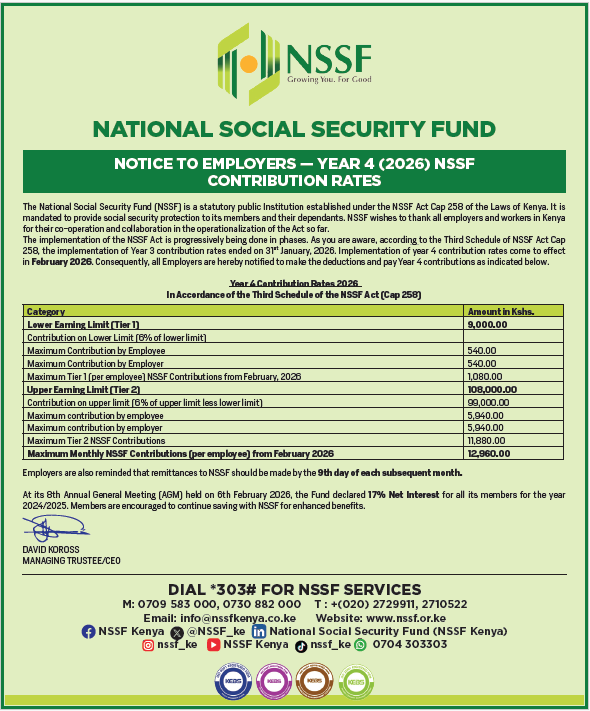
Employer NSSF and AHL change with gross pay, and NSSF has a ceiling. The two scenarios show salary plus those employer contributions, before other costs or a provider fee.
| Cost line | 2025 modern-sector annual-earnings monthly equivalent | Indicative Nairobi senior software engineer |
|---|---|---|
| Gross monthly salary | KES 82,348.13 | KES 340,000 |
| Employer NSSF Tier I | KES 540 | KES 540 |
| Employer NSSF Tier II | KES 4,400.89 | KES 5,940 |
| Employer AHL | KES 1,235.22 | KES 5,100 |
| NSSF plus AHL | KES 6,176.11 | KES 11,580 |
| Salary plus NSSF and AHL subtotal | KES 88,524.24 | KES 351,580 |
The first salary divides KNBS's provisional 2025 modern-sector annualised June earnings of KES 988,177.50 by 12; it is neither an observed 2026 monthly wage nor a technology-sector salary. The second is an indicative 2025 Nairobi senior software-engineer reference. Both subtotals exclude NITA's KES 50 per employee per month, employer-specific WIBA insurance, benefits, the provider fee and any applicable VAT. PAYE and SHIF are worker deductions, not matching employer contributions.
Why 7.5% stops describing the whole salary range
Employer NSSF is 6% on two disjoint bands: the first KES 9,000 in Tier I and the next KES 99,000 in Tier II. Its combined monthly employer maximum is KES 6,480. Employer AHL adds 1.5% of gross salary, so the nominal combined rate is 7.5% only within the NSSF earnings limit. Above that limit, the effective rate falls; at KES 340,000, NSSF plus AHL is 3.41% of gross pay.
Check the offer against the job and area wage floor
Match the role and work area to Kenya's applicable wage order before treating the gross figure as the starting point for an EOR calculation. The general wage schedule sets basic pay exclusive of housing, while the agricultural schedule is separate and uses consolidated rates; the contract must state whether it includes a housing element. Use the Kenya hiring guide for the occupation and area wage lookup rather than applying one national minimum.
How the July 2026 VAT rule changes an outsourcing invoice
From 1 July 2026, Finance Act 2026 section 26 treats employee-related costs as client disbursements where a supplier provides labour, outsourcing or employee-placement services and incurs those costs, subject to VAT Act section 13(5). The provision covers salaries, wages, statutory deductions and related costs, but it does not establish that every EOR arrangement, reimbursement or provider invoice item receives the same treatment.
For a qualifying supply, ask the provider to identify the service, itemise the employee-related costs it incurred and explain how VAT Act section 13(5) applies to the invoice. Review the supplier's service fee separately: the rule does not make that fee automatically VAT-free. The statutory change does not state a retroactive result for an earlier invoice period.
Where the EOR model runs out in Kenya
An EOR contract does not by itself settle immigration, permanent-establishment, IP or employment-claim questions for the client. Those outcomes depend on the named employer, the work and the parties' conduct. No universal maximum EOR duration is confirmed for Kenya arrangements.
Foreign employee and Class D: the employer must match the file
A Class D application concerns a specific job with a specific employer and requires employer documents, a Kenyan understudy and evidence of recruitment from the local labour market. Compare the employer named in the signed offer, statutory records and permit file before work begins; an EOR arrangement alone does not establish sponsorship eligibility. The published fees are KES 20,000 for processing and KES 500,000 for annual issuance where applicable, with EAC member-state fees gratis.
Permanent establishment follows the client’s activities
Using a Kenyan legal employer does not decide the client's permanent-establishment position. Kenya's statutory tests include a fixed place of business, services in Kenya exceeding 91 days in a 12-month period, and a dependent agent that habitually concludes or plays the principal role in concluding contracts. Review the client's activities, personnel and contracts against the applicable treaty and facts rather than relying on an EOR label.
IP, dismissal and employee claims still need an owner
The contracts should map the rights chain from worker to Kenyan provider to client. Kenyan copyright law deems genuinely commissioned work transferred to the commissioner unless the parties limit or exclude that result, while moral rights remain with the author; a separate assignment or exclusive licence must be written and signed, and the current Act requires recordal for an assignment under section 33(3). Identify commissioned deliverables, pre-existing assets and non-copyright rights instead of assuming a standard EOR agreement resolves ownership.
The actual legal employer must still run the employment process. Written terms, the applicable wage order, work-injury cover, notice and fair procedure remain relevant, including a fair hearing during probation; for unjustified termination, a labour officer may recommend compensation of up to 12 months of gross salary. The client and provider can allocate responsibilities between themselves, but that allocation does not automatically determine the employee's statutory rights or eliminate claims arising from the actual relationship.
When can you hire in Kenya without an EOR?
You may be able to employ a Kenyan worker directly without an EOR or Kenyan entity, but the foreign employer still carries the local employment, tax, social-security and other regulatory duties. A payroll agent can administer tasks for that employer, yet it does not replace the foreign company as legal employer under the agent model. For a foreign national, the employer named in the signed contract and statutory records should also match the employer in the relevant work-authorisation file.
An own Kenyan company or branch is another route when you want the entity itself to hold the employer role. BRS publishes a three-to-five-day service estimate for the company or branch registry step, but that estimate does not cover the remaining employer registrations or a complete hiring timeline. The Kenya hiring guide covers the registration path and ongoing employer baseline.
Genuinely independent services are a different worker relationship, not an alternative label for an employee. Kenyan courts look at control, integration, economic reality and mutuality of obligation; a relationship with employee-like features needs an employment route rather than a contractor form.
Which alternative fits the worker and the work?
Choose the route by identifying the actual employer or counterparty and the nature of the work, rather than by relying on an EOR, PEO or payroll label. A provider that only administers payroll stays within the route of the entity that remains the legal employer.
| Route | Legal employer or counterparty | Setup dependency | When it fits |
|---|---|---|---|
| Own Kenyan entity or branch | Kenyan company or branch | BRS registration is a distinct registry step; then complete the applicable employer registrations | You want a Kenyan entity to employ the worker directly |
| Legal-employer EOR | Kenyan provider | Verify the provider signs the employment contract; assess agency registration only if it procures employment | The provider genuinely holds the local employer role for an employee |
| Direct foreign employment | Foreign client | The foreign employer retains Kenya employment and payroll duties; align any foreign-worker file with that employer | You can carry the local employer obligations without a Kenyan employing entity |
| Genuine independent contractor | Contractor is the counterparty | Test the actual relationship for control, integration, economic reality and mutuality of obligation | The work is independently performed and does not operate as employee-like work |
For a foreign national, the Class D process concerns a specific job with a specific employer, so the chosen employer route, signed contract and application file must agree. The Kenya contractor guide covers genuinely independent services; a contractor label does not change an employment relationship.
How to choose a Kenya EOR provider
Ask for documents that identify the employer, the service performed and the records behind the quote; a provider label alone does not answer those questions.
- Who is the legal employer? Request the employee contract naming the employer, the client–provider services agreement, and confirmation of whose name appears on PAYE, NSSF and other statutory records. If the offer is an agent model, record that the foreign client remains the employer.
- Who recruits or places the worker? Identify the entity that performs that function. If it procures employment, ask for its NEA registration details and check the public register; do not treat an EOR title as proof that an agency licence is either required or unnecessary.
- Which background checks fit the role? Ask which role-specific checks the provider proposes, who obtains the worker's consent, and what record the legal employer will keep. Do not treat screening as a universal Kenya requirement.
- Who owns the worker-side obligations? Obtain the employing entity's plan for PAYE, NSSF, NITA, SHA and work-injury cover, plus the written employment particulars and the authority that will run any dismissal process. For a foreign employee, compare the named employer, signed contract, payroll record and Class D application documents.
- What does the cost worksheet include? Request a line-item NSSF and AHL worksheet for the actual gross pay, showing the NSSF bands and cap. Keep NITA's KES 50 monthly levy, the employer-specific WIBA premium, benefits, the provider fee and any applicable VAT outside a salary-plus-NSSF-and-AHL subtotal; PAYE and SHIF are worker deductions.
- What does the invoice rule apply to? Ask the provider to identify whether it supplies labour, outsourcing or employee-placement services and to separate employee-related costs from its service fee. The July 2026 Finance Act rule is subject to VAT Act section 13(5) and does not settle every invoice item.
- Who has reviewed client-specific boundaries? Request the named party's review of the client's Kenya activities for permanent-establishment questions, the rights chain from worker to provider to client, and the authority and records for an exit. These are fact-specific checks, not terms that an EOR agreement resolves automatically.
Questions people actually ask
Can I hire an employee in Kenya without setting up a company?
A foreign company may be able to employ a Kenyan resident without a Kenyan entity, but it still carries Kenya's employment, tax, social-security and other regulatory duties. A payroll agent can administer work for the foreign employer, whereas a legal-employer EOR contracts with the worker in its own role.
Does a Kenya EOR need an NEA recruitment agency licence?
Check agency registration when a provider acts as an intermediary to procure employment. Ask which entity recruits or places the worker, then check the NEA validity register where that function applies. The EOR label alone does not settle the licence question.
How do I know which company is the legal employer?
Read the employee's signed contract and statutory records first. In a legal-employer model the Kenyan provider contracts with the worker; in an agent model the foreign client remains the employer, even where a provider administers payroll or other tasks.
How long does it take to hire through an EOR in Kenya?
There is no single established end-to-end EOR onboarding period. BRS's three-to-five-day estimate covers only registration of an own company or foreign-company branch; employment terms, registrations, any recruitment-function check and work-authorisation review add separate dependencies.
What does a Kenya EOR cost beyond salary?
Employer NSSF is capped at KES 6,480 per month and employer AHL is 1.5% of gross salary; the combined effective rate changes when salary exceeds the NSSF ceiling. Add NITA's KES 50 monthly levy, employer-specific WIBA insurance, benefits, the provider fee and any applicable VAT separately; PAYE and SHIF are worker deductions. For qualifying labour, outsourcing or employee-placement supplies from 1 July 2026, employee-related costs are deemed disbursements subject to VAT Act section 13(5); the provider's service fee still needs its own invoice treatment.
Can an EOR sponsor a Class D permit for my foreign employee?
An EOR contract alone does not establish eligibility to sponsor a Class D application. The permit concerns a specific job with a specific employer, so the employer in the contract, statutory records and application should align, alongside the required recruitment evidence and Kenyan understudy.
Will using a Kenya EOR prevent a permanent establishment?
No. Kenya's statutory tests include a fixed place of business, services in Kenya exceeding 91 days in a 12-month period, and a dependent agent that habitually concludes or plays the principal role in concluding contracts. Review the client's activities and any applicable treaty rather than relying on the EOR arrangement.
What happens if the employee is dismissed?
The actual legal employer must follow the applicable notice and fair-procedure rules, including a fair hearing during probation. For monthly-paid work, the statutory notice baseline is 28 days, and a labour officer may recommend compensation of up to 12 months of gross salary for unjustified termination.
Sources
- 4dev.com. Kenya hiring guide. Accessed 25 October 2026.
- 4dev.com. Contractor Platform. Accessed 20 October 2026.
- 4dev.com. Employer of record glossary. Accessed 20 October 2026.
- State Department for Diaspora Affairs. Verify Licensed Recruitment Agencies. Accessed 23 October 2026.
- Kenya Law. Labour Institutions Act (Cap. 234), legislation as at 11 December 2023. Accessed 23 October 2026.
- Oraro & Company Advocates. The Legal Kenyan, Issue 21, July 2025. Accessed 23 October 2026.
- Owino-O & Associates. Employer of Record Arrangements – Managing Employment Risk Beyond the Contract. Accessed 23 October 2026.
- Kenya Law. Employment Act (Cap. 226), legislation as at 22 March 2024. Accessed 23 October 2026.
- National Social Security Fund. Frequently Asked Questions. Accessed 23 October 2026.
- Kenya Revenue Authority. Pay As You Earn (PAYE). Accessed 23 October 2026.
- Kenya Revenue Authority. Finance Act 2026. Accessed 23 October 2026.
- 4dev.com. Kenya independent contractors guide. Accessed 25 October 2026.
- 4dev.com. Global contractor platform. Accessed 23 October 2026.
- 4dev.com. Countries available for contractors. Accessed 23 October 2026.
- Kenya Law. Regulation of Wages (General) (Amendment) Order, 2026, Legal Notice 108. Accessed 23 October 2026.
- Kenya Law. Regulation of Wages (Agricultural Industry) (Amendment) Order, 2026, Legal Notice 109. Accessed 23 October 2026.
- Kenya Law. Work Injury Benefits Act (Cap. 236). Accessed 23 October 2026.
- Kenya Law. [Employment and Labour Relations Court [2025] KEELRC 2980](https://new.kenyalaw.org/akn/ke/judgment/keelrc/2025/2980/eng%402025-10-30/source.pdf). Accessed 23 October 2026.
- Kenya Law. Labour Institutions (Private Employment Agencies) Regulations, LN 110 of 2016. Accessed 23 October 2026.
- Njoroge Regeru & Company Advocates. The Interplay Between Copyright Ownership (Intellectual Property), Contracts of Service and Contracts for Service. Accessed 23 October 2026.
- Directorate of Immigration Services. Class D (Employment). Accessed 23 October 2026.
- Kenya Revenue Authority. Companies & Partnerships PIN Registration. Accessed 23 October 2026.
- Kenya Revenue Authority. Tax Obligations. Accessed 23 October 2026.
- National Industrial Training Authority. Levy Inspectorate. Accessed 23 October 2026.
- National Social Security Fund. Notice to Employers — Year 4 (2026) NSSF Contribution Rates. Accessed 23 October 2026.
- Kenya Revenue Authority. Collection of Affordable Housing Levy by Kenya Revenue Authority. Accessed 23 October 2026.
- Business Registration Service. Fee Schedule — Companies Registry. Accessed 23 October 2026.
- Kenya National Bureau of Statistics. Economic Survey 2026. Accessed 23 October 2026.
- Two Max Group. Compensation & Benefits Benchmarking Kenya. Accessed 23 October 2026.
- Ministry of Health. Social Health Insurance (General) Regulations, 2024. Accessed 23 October 2026.
- Kenya Revenue Authority. Finance Act 2026: what it means for you. Accessed 23 October 2026.
- Kenya Law. Income Tax Act (Cap. 470), legislation as at 1 July 2025. Accessed 23 October 2026.
- Kenya Law. Copyright Act (Cap. 130), revised 2022. Accessed 23 October 2026.
- Kenya Law. UAP Life Assurance Company Limited v Commissioner of Domestic Taxes. Accessed 23 October 2026.
- Kenya Law. [Employment and Labour Relations Court judgment [2022] KEELRC 890](https://new.kenyalaw.org/akn/ke/judgment/keelrc/2022/890/eng@2022-02-03/source.pdf). Accessed 23 October 2026.